How to Fund Accessible Home Renovations with a Home Equity Sharing Agreement
Most Canadians want to age in place at home rather than move into a long-term care facility. After years or decades living in the same place, you want to be surrounded by the neighbours you know and the streets you’re familiar with, and be able to maintain your sense of independence in retirement.
But most homes weren’t built with accessibility in mind, and often require renovations to make them safe to remain in while aging.
Two professional designations have emerged in recent years to address this challenge. Certified Aging-in-Place Specialists (CAPS) and Qualified Adaptiv Home Specialists (QAHS) are trained to help seniors renovate their homes to address their current and future accessibility and safety needs, while still prioritizing design and functionality.
Planning ahead and making these modifications early can prevent falls and other safety risks later. But retirees generally have few ways to fund a renovation without taking on debt and adding a new expense to what could be a fixed monthly budget. While the federal Home Accessibility Tax Credit can help, it only provides a non-refundable tax reduction of up to $3,000 after you’ve already paid for the work upfront. A survey by March of Dimes Canada found that while four in five Canadian seniors want to remain in their current home as they age, only one-quarter think they’ll be able to do it, with renovation costs identified as the single biggest barrier.
A Home Equity Sharing Agreement (HESA) offers a new and practical way to access your home equity to fund these home modifications without taking on debt or making monthly payments.
How a Home-Accessibility Specialist Can Help You Age Comfortably at Home
Certified Aging-in-Place Specialists (CAPS) and Qualified Adaptiv Home Specialists (QAHS) are professionals in the renovation and design sectors who have been trained on accessible home design for seniors and people with mobility challenges. Look for either designation if you want to work with a professional who can help you age safely at home while maintaining your home’s style.
CAPS are professional renovators and homebuilders who’ve completed an online and in-class course with the National Association of Home Builders in the United States. The designation has been around since the early 2000s, and Canadian professionals have also completed it. In 2022, the Canadian Home Builders’ Association launched a course for renovators, occupational therapists, and other professionals that gives them the designation of Qualified Adaptiv Home Specialist.
Both courses teach participants about the home modifications that can improve seniors’ safety and quality of life, as well as relevant building codes and standards and other professionals they might need to collaborate with. The courses also give participants training in client communication, and insurance and legal considerations.
A home-accessibility specialist can conduct an initial home assessment, and hire the contractors to complete the home modifications that will preserve your mobility and independence into the future, such as:
- Accessibility upgrades (e.g., ramps, barrier-free entries, wider doorways, stairlifts, and barrier-free showers)
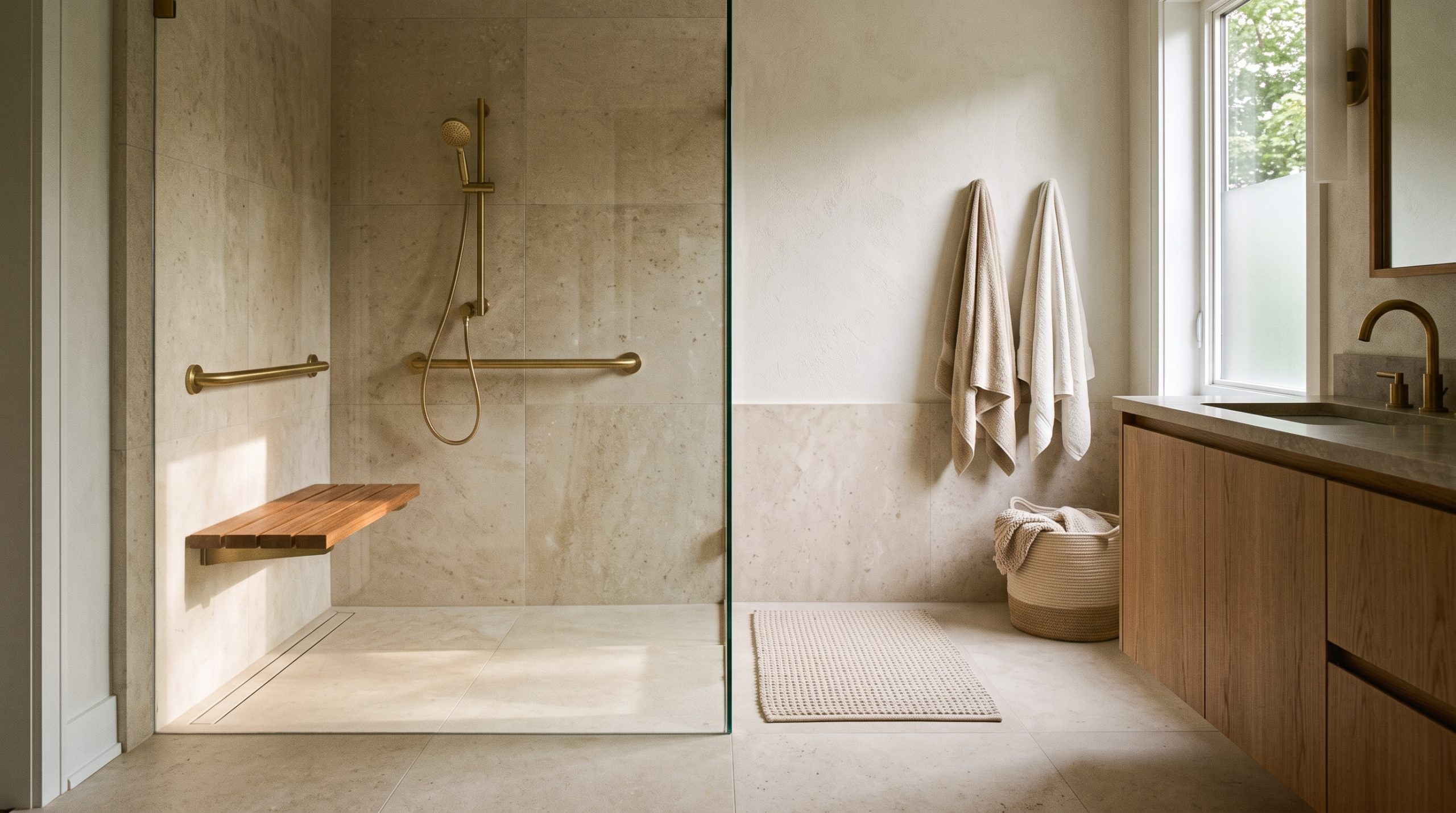
- Safety upgrades to reduce fall risks (e.g., slip-resistant flooring, grab bars and handrails, shower seating, and better lighting)
- Smart home technologies (e.g., voice-activated controls, emergency alert systems, and automated lighting)
What Do Accessible Home Renovations Cost?
Accessibility renovations for Ontario homeowners can range from a few hundred dollars for basic safety upgrades like adding grab bars and handrails in the bathroom to $50,000 to $80,000 or more for major reconfigurations of bathrooms, doorways, lighting and the main bedroom. In dense cities like those in the Greater Toronto Area homes are often built with smaller bathrooms and use multiple storeys to maximize livable space, which can make accessibility renovations more complex.
Receiving an assessment from a home-accessibility specialist will typically cost between $200 and $500, and they may either charge an hourly rate for their ongoing work or build the cost into the overall renovation.
Funding Renovations Often Means Taking on Debt
With limited government grants or tax incentives available for accessible renovations, many seniors turn to their home equity or retirement savings to finance these costs. But the existing options come with trade-offs to consider: monthly payments on a home equity line of credit balance that could rise if interest rates do, an accruing interest balance on a reverse mortgage, or a steep tax bill when withdrawing lump sums from an RRSP or RRIF.
The HESA: A Debt-Free Option for Tapping Home Equity
A Home Equity Sharing Agreement from Clay Financial is a new way to access your home equity to fund aging-in-place renovations without taking on debt or monthly payments.
With our HESA, you can receive up to 17.5% of the appraised value of your home (up to a maximum of $500,000) as a tax-free, lump-sum payment. Instead of lending you money, Clay becomes your partner in home equity, sharing in your home’s future change in value. At the end of the contract, you make a single payment equal to the original amount you received, plus (or minus) our share of your home’s appreciation (or depreciation). Your HESA can last up to 25 years, or end earlier if you sell your home, buy out the agreement (anytime after year five), or pass away.
Our agreement is structured to protect the existing equity you’ve spent years building. If your home appreciates, we share in a portion of that future growth. And if the market drops when you sell after the initial five years, we share in that loss too, meaning your final payment to Clay is lower. Since a HESA is a financial contract and not a loan, there are no monthly payments and no interest quietly compounding in the background. Your retirement budget remains intact while you make the modifications needed to maintain your independence.
Capturing Your Renovation Value: Clay’s Home Improvement Adjustment
Your home modifications could also qualify for Clay’s Home Improvement Adjustment. At the beginning and end of your HESA, an independent appraiser conducts a fair market value appraisal of your home. If you make renovations during your term, you simply follow our process to notify us of the improvements and document your changes. We share those records with the appraiser at the end of the HESA. If the appraisal finds that your upgrades increased the market value of your home, we subtract that added value before calculating our share—ensuring you keep 100% of the incremental appreciation your investment created.
How a HESA Works for Aging in Place: Two Examples
Consider these examples of how the HESA could help two senior couples remain comfortably in their homes.
The Split-Level Home
The renovation: John and Jane’s master bedroom and only full bathroom are on the second floor of their 1970s split-level home, and John, while otherwise healthy, is starting to struggle with the stairs. They engage a home-accessibility specialist, who recommends expanding a small first-floor guest bedroom into a master bedroom and taking away some dining room space to convert a half-bathroom into a full with a barrier-free shower. The renovation is quoted at $80,000, including the home-accessibility specialist’s fees.
The challenge: Despite having a lot of equity built up in their home, John and Jane have a fairly fixed retirement budget based on their combined Canada Pension Plan and old age security payments, and some small personal savings. They have an existing HELOC, but adding another payment to their budget would leave them with little breathing room at the end of the month.
The HESA solution: Using a HESA allows the couple to renovate their home before John’s mobility deteriorates further, and age safely in place. They follow Clay’s Home Improvement Adjustment process and notify us about their renovations, with documentation. At the end of their HESA, the appraiser determines that converting the half-bathroom into a full bathroom added $10,000 to the home’s value, and Clay excludes that entire $10,000 from the shared appreciation calculation.
2. The Bungalow
The renovation:Tom and Jacob’s bungalow is almost perfect for aging in place. But when Tom starts using a wheelchair part-time, they realize their doorways need to be widened, the three steps at their front door are a challenge, and the bathroom needs to be modified for accessibility. They work with a Qualified Adaptiv Home Specialist renovator, who also recommends better lighting and smart home technology. The total renovation would come to $50,000.
The challenge: While Tom and Jacob have enough in their Registered Retirement Income Funds (RRIFs) to cover the cost of the renovation, it would drastically change their retirement financial plan. While they have a small HELOC available, they use it for short-term borrowing and don’t want to stretch their monthly budget by adding long-term monthly payments. They consider a reverse mortgage, but do not want to give up the flexibility of their current HELOC and are worried what might happen to their existing home equity if interest rates continue to rise in the future.
The HESA solution: By using the HESA, the couple is able to make the necessary home renovations without disrupting their financial plan for retirement while protecting their existing home equity to fund their estate plans.
Plan Ahead for Your Home Accessibility Needs
A HESA could be the right fit if you want to prepare your home for future mobility needs without squeezing your monthly budget or triggering a tax hit from your retirement savings. It gives you the flexibility to age in place on your own terms, without worrying about your hard-earned equity being whittled away by accruing interest.
To see how much equity you could potentially access, get your no-obligation estimate from Clay Financial today.